Ponder a while, maybe even leave a comment. I'm still thinking about it, but will log my thoughts at a later date.
Saturday, 22 August 2009
Is This What Comes To Mind When You Think of Trinity?
Have a look at this video clip from the film Multiplicity:
Is this what you think of when you think of the Trinity? Essentially an original master (Father) with two carbon copies of himself, (Son and Spirit) that are just subordinate in authority and different in function to him? Is there anything deficient in this view?
Super Saturdays in Summer
Today, I went up the Sugarloaf (see below) with my housemate Richard (see right). He is my brother in every way, (except biological).Eighteen months ago, I wrote off his car, which would have been fine, if he had asked me to... but he didn't. He was very gracious to me through the whole saga, despite all the inconvenience etc it caused him. Moreover, since then, he has offered me his new car to drive on a number of different occasions, which I have refused. The shame of the original crash and the fear of repeating the experience have meant that I have, thus far, avoided taking him up on the offer.
However this morning, due to him waking up with a sore neck, and my not wanting to look like a coward, I shared the drive to Wales with him in his ("30-times-nicer-than-my-jalopy") car. I didn't crash it and in fact, somewhat to my surprise, I very much enjoyed creating and feeling a level of torque that my Micra could only dream about.
We had a great day, sharing as men our reflections on life thus far as we know it, our hopes and fears, our joys and frustrations, as well as some appalling jokes (none of which would be funny to you if I tried to retell them. But then I guess that's one of the things that makes friendships special.)
Thank you Jesus for a great friend and a great day!
Thursday, 20 August 2009
Don't Let the Busyness of Life, Give You Amnesia of Soul.
I constantly need videos like this to remind me what we're really here for. The message is not difficult to understand, but keeping it at the forefront of the mind is really hard:
Sponsoring a native missionary is cheaper than sending a Western one. Something you might want to think about.
The words you heard were taken from here.
Sponsoring a native missionary is cheaper than sending a Western one. Something you might want to think about.
Wednesday, 19 August 2009
A Shadow of Hell: Western Style
---
Democracy as a political system, summed up in the slogan: "All people must be treated fairly" is something that can be actively promoted and encouraged. The danger comes when that political system is hijacked and forced into the service of philosophy, morality and aesthetics, summed up in the slogans "All people are equal." and "All ideas must be treated equally."
Reflecting on this, I wonder whether, what (the movement known as) "evangelical Christianity" assumes for its doctrine of human dignity, rests more on clichés of humanist nostalgia than it likes to think. Its critics have certainly claimed that impression!
Fair treatment of persons under the law is to be pursued at all costs, but that is not the same as philosophical and moral democracy, which is a different monster altogether and is to be opposed at all costs, because it will, in the end, lead to the abolition of the personality and worse, the destruction of the human soul.
To elucidate further on this, I leave the floor to C. S. Lewis' character Screwtape; a senior demon addressing a bunch of graduating demons as they embark on their careers of casting as many souls into perdition as possible (emphases mine, full text here although you'll have to scroll a long way down...):
Democracy is the word with which you must lead them by the nose. The good work which our philological experts have already done in the corruption of human language makes it unnecessary to warn you that they should never be allowed to give this word a clear and definable meaning. They won't. It will never occur to them that Democracy is properly the name of a political system, even a system of voting, and that this has only the most remote and tenuous connection with what you are trying to sell them. Nor of course must they ever be allowed to raise Aristotle's question: whether ''democratic behaviour" means the behaviour that democracies like or the behaviour that will preserve a democracy. For if they did, it could hardly fail to occur to them that these need not be the same. You are to use the word purely as an incantation; if you like, purely for its selling power. It is a name they venerate. And of course it is connected with the political ideal that men should be equally treated. You then make a stealthy transition in their minds from this political ideal to a factual belief that all men are equal. Especially the man you are working on. As a result you can use the word Democracy to sanction in his thought the most degrading (and also the least enjoyable) of all human feelings. You can get him to practise, not only without shame but with a positive glow of self-approval, conduct which, if undefended by the magic word, would be universally derided.
The feeling I mean is of course that which prompts a man to say "I'm as good as you."
The first and most obvious advantage is that you thus induce him to enthrone at the centre of his life a good, solid resounding lie. I don't mean merely that his statement is false in fact, that he is no more equal to everyone he meets in kindness, honesty, and good sense than in height or waist-measurement. I mean that he does not believe it himself. No man who says "I'm as good as you" believes it. He would not say it if he did. The St. Bernard never says it to the toy dog, nor the scholar to the dunce, nor the employable to the bum, nor the pretty woman to the plain. The claim to equality, outside the strictly political field, is made only by those who feel themselves to be in some way inferior. What it expresses is precisely the itching, smarting, writhing awareness of an inferiority, which the patient refuses to accept. And therefore resents. Yes, and therefore resents every kind of superiority in others; denigrates it; wishes its annihilation. Presently he suspects every mere difference of being a claim to superiority. No one must be different from himself in voice, clothes, manners, recreations, choice of food. "Here is someone who speaks English rather more clearly and euphoniously than I it must be a vile, upstage, lah-di-dah affectation. Here's a fellow who says he doesn't like hot dogs thinks himself too good for them no doubt. Here's a man who hasn't turned on the jukebox he's one of those highbrows and is doing it to show off. If they were the right sort of chaps, they'd be like me. They've no business to be different. It's undemocratic."
Now this useful phenomenon is in itself by no means new. Under the name of Envy it has been known to the humans for thousands of years. But hitherto they always regarded it as the most odious, and also the most comical, of vices. Those who were aware of feeling it felt it with shame; those who were not gave it no quarter in others. The delightful novelty of the present situation is that you can sanction it make it respectable and even laudable by the incantatory use of the word democratic.
Under the influence of this incantation those who are in any or every way inferior can labour more whole-heartedly and successfully than ever before to pull down everyone else to their own level. But that is not all. Under the same influence, those who come, or could come, nearer to a full humanity, actually draw back from it for fear of being undemocratic. I am credibly informed that young humans now sometimes suppress an incipient taste for classical music or good literature because it might prevent their being "Like Folks"; that people who would really wish to be and are offered the Grace which would enable them to be honest, chaste, or temperate, refuse it. To accept might make them Different, might offend against the Way of Life, take them out of Togetherness, impair their Integration with the Group. They might (horror of horrors!) become individuals.
All is summed up in the prayer, which a young female human is said to have uttered recently: "Oh God, make me a normal twentieth-century girl!" Thanks to our labours, this will mean increasingly, "Make me a minx, a moron, and a parasite."
Meanwhile, as a delightful by-product, the few (fewer every day) who will not be made Normal and Regular and Like Folks and Integrated, increasingly tend to become in reality the prigs and cranks which the rabble would in any case have believed them to be. For suspicion often creates what it suspects. ("Since, whatever I do, the neighbours are going to think me a witch, or a Communist agent, I might as well be hanged for a sheep as a lamb and become one in reality.") As a result we now have an intelligentsia, which, though very small, is very useful to the cause of Hell.
But that is a mere by-product. What I want to fix your attention on is the vast, over-all movement towards the discrediting, and finally the elimination, of every kind of human excellence moral, cultural, social, or intellectual. And is it not pretty to notice how Democracy (in the incantatory sense) is now doing for us the work that was once done by the most ancient Dictatorships, and by the same methods? You remember how one of the Greek Dictators (they called them "tyrants' then) sent an envoy to another Dictator to ask his advice about the principles of government. The second Dictator led the envoy into a field of grain, and there he snicked off with his cane the top of every stalk that rose an inch or so above the general level. The moral was plain. Allow no pre-eminence among your subjects. Let no man live who is wiser, or better, or more famous, or even handsomer than the mass. Cut them all down to a level; all slaves, all ciphers, all nobodies. All equals. Thus Tyrants could practise, in a sense, "democracy."

But now "democracy" can do the same work without any other tyranny than her own. No one need now go through the field with a cane. The little stalks will now of themselves bite the tops off the big ones. The big ones are beginning to bite off their own in their desire to Be Like Stalks.
I have said that to secure the damnation of these little souls, these creatures that have almost ceased to be individual, is a laborious and tricky work. But if proper pains and skill are expended, you can be fairly confident of the result. The great sinners seem easier to catch. But then they are incalculable. After you have played them for seventy years, the Enemy may snatch them from your claws in the seventy-first. They are capable, you see, of real repentance. They are conscious of real guilt. They are, if things take the wrong turn, as ready to defy the social pressures around them for the Enemy’s sake, as they were to defy them for ours. It is in some ways more troublesome to track and swat an evasive wasp than to shoot, at close range, a wild elephant. But the elephant is more troublesome if you miss.
My own experience, as I have said, was mainly on the English sector, and I still get more news from it than from any other. It may be that what I am now going to say will not apply so fully to the sectors in which some of you may be operating. But you can make the necessary adjustments when you get there. Some application it will almost certainly have. If it has too little, you must labour to make the country you are dealing with more like what England already is.
In that promising land the spirit of "I'm as good as you" has already become something more than a generally social influence. It begins to work itself into their educational system. How far its operations there have gone at the present moment, I would not like to say with certainty. Nor does it matter. Once you have grasped the tendency, you can easily predict its future developments; especially as we ourselves will play our part in the developing. The basic principle of the new education is to be that dunces and idlers must not be made to feel inferior to intelligent and industrious pupils. That would be "undemocratic.' These differences between the pupils, for they are obviously and nakedly individual differences, must be disguised. This can be done on various levels. At universities, examinations must be framed so that nearly all the students get good marks. Entrance examinations must be framed so that all, or nearly all, citizens can go to universities, whether they have any power (or wish) to profit by higher education or not. At schools, the children who are too stupid or lazy to learn languages and mathematics and elementary science can be set to doing the things that children used to do in their spare time. Let them, for example, make mud-pies and call it modelling. But all the time there must be no faintest hint that they are inferior to the children who are at work. Whatever nonsense they are engaged in must have I believe the English already use the phrase "parity of esteem.' An even more drastic scheme is not impossible. Children who are fit to proceed to a higher class may be artificially kept back, because the others would get a trauma Beelzebub, what a useful word! by being left behind. The bright pupil thus remains democratically fettered to his own age-group throughout his school career, and a boy who would be capable of tackling Aeschylus or Dante sits listening to his coeval’s attempts to spell out A CAT SAT ON A MAT.
In a word, we may reasonably hope for the virtual abolition of education when "I'm as good as you" has fully had its way. All incentives to learn and all penalties for not learning will vanish. The few who might want to learn will be prevented; who are they to overtop their fellows? And anyway the teachers or should I say, nurses? will be far too busy reassuring the dunces and patting them on the back to waste any time on real teaching. We shall no longer have to plan and toil to spread imperturbable conceit and incurable ignorance among men. The little vermin themselves will do it for us.
Of course this would not follow unless all education became state education. But it will. That is part of the same movement. Penal taxes, designed for that purpose, are liquidating the Middle Class, the class who were prepared to save and spend and make sacrifices in order to have their children privately educated. The removal of this class, besides linking up with the abolition of education, is, fortunately, an inevitable effect of the spirit that says "I'm as good as you." This was, after all, the social group which gave to the humans the overwhelming majority of their scientists, physicians, philosophers, theologians, poets, artists, composers, architects, jurists, and administrators. If ever there was a bunch of tall stalks that needed their tops knocked off, it was surely they. As an English politician remarked not long ago, "A democracy does not want great men."
It would be idle to ask of such a creature whether by want it meant "need" or "like." But you had better be clear. For here Aristotle's question comes up again.
We, in Hell, would welcome the disappearance of Democracy in the strict sense of that word; the political arrangement so called. Like all forms of government it often works to our advantage; but on the whole less often than other forms. And what we must realize is that "democracy" in the diabolical sense ("I'm as good as you", Being like Folks, Togetherness) is the finest instrument we could possibly have for extirpating political Democracies from the face of the earth.
For "democracy" or the "democratic spirit" (diabolical sense) leads to a nation without great men, a nation mainly of subliterates, full of the cocksureness which flattery breeds on ignorance, and quick to snarl or whimper at the first hint of criticism. And that is what Hell wishes every democratic people to be. For when such a nation meets in conflict a nation where children have been made to work at school, where talent is placed in high posts, and where the ignorant mass are allowed no say at all in public affairs, only one result is possible.
The Democracies were surprised lately when they found that Russia had got ahead of them in science. What a delicious specimen of human blindness! If the whole tendency of their society is opposed to every sort of excellence, why did they expect their scientists to excel?
It is our function to encourage the behaviour, the manners, the whole attitude of mind, which democracies naturally like and enjoy, because these are the very things which, if unchecked, will destroy democracy. You would almost wonder that even humans don't see it themselves. Even if they don't read Aristotle (that would be undemocratic) you would have thought the French Revolution would have taught them that the behaviour aristocrats naturally like is not the behaviour that preserves aristocracy. They might then have applied the same principle to all forms of government.
But I would not end on that note. I would not Hell forbid! Encourage in your own minds that delusion which you must carefully foster in the minds of your human victims. I mean the delusion that the fate of nations is in itself more important than that of individual souls. The overthrow of free peoples and the multiplication of slave-states are for us a means (besides, of course, being fun); but the real end is the destruction of individuals. For only individuals can be saved or damned, can become sons of the Enemy or food for us. The ultimate value, for us, of any revolution, war, or famine lies in the individual anguish, treachery, hatred, rage, and despair, which it may produce. "I'm as good as you" is a useful means for the destruction of democratic societies. But it has a far deeper value as an end in itself, as a state of mind which, necessarily excluding humility, charity, contentment, and all the pleasures of gratitude or admiration, turns a human being away from almost every road which might finally lead him to Heaven.
Democracy is the word with which you must lead them by the nose. The good work which our philological experts have already done in the corruption of human language makes it unnecessary to warn you that they should never be allowed to give this word a clear and definable meaning. They won't. It will never occur to them that Democracy is properly the name of a political system, even a system of voting, and that this has only the most remote and tenuous connection with what you are trying to sell them. Nor of course must they ever be allowed to raise Aristotle's question: whether ''democratic behaviour" means the behaviour that democracies like or the behaviour that will preserve a democracy. For if they did, it could hardly fail to occur to them that these need not be the same. You are to use the word purely as an incantation; if you like, purely for its selling power. It is a name they venerate. And of course it is connected with the political ideal that men should be equally treated. You then make a stealthy transition in their minds from this political ideal to a factual belief that all men are equal. Especially the man you are working on. As a result you can use the word Democracy to sanction in his thought the most degrading (and also the least enjoyable) of all human feelings. You can get him to practise, not only without shame but with a positive glow of self-approval, conduct which, if undefended by the magic word, would be universally derided.
The feeling I mean is of course that which prompts a man to say "I'm as good as you."
The first and most obvious advantage is that you thus induce him to enthrone at the centre of his life a good, solid resounding lie. I don't mean merely that his statement is false in fact, that he is no more equal to everyone he meets in kindness, honesty, and good sense than in height or waist-measurement. I mean that he does not believe it himself. No man who says "I'm as good as you" believes it. He would not say it if he did. The St. Bernard never says it to the toy dog, nor the scholar to the dunce, nor the employable to the bum, nor the pretty woman to the plain. The claim to equality, outside the strictly political field, is made only by those who feel themselves to be in some way inferior. What it expresses is precisely the itching, smarting, writhing awareness of an inferiority, which the patient refuses to accept. And therefore resents. Yes, and therefore resents every kind of superiority in others; denigrates it; wishes its annihilation. Presently he suspects every mere difference of being a claim to superiority. No one must be different from himself in voice, clothes, manners, recreations, choice of food. "Here is someone who speaks English rather more clearly and euphoniously than I it must be a vile, upstage, lah-di-dah affectation. Here's a fellow who says he doesn't like hot dogs thinks himself too good for them no doubt. Here's a man who hasn't turned on the jukebox he's one of those highbrows and is doing it to show off. If they were the right sort of chaps, they'd be like me. They've no business to be different. It's undemocratic."
Now this useful phenomenon is in itself by no means new. Under the name of Envy it has been known to the humans for thousands of years. But hitherto they always regarded it as the most odious, and also the most comical, of vices. Those who were aware of feeling it felt it with shame; those who were not gave it no quarter in others. The delightful novelty of the present situation is that you can sanction it make it respectable and even laudable by the incantatory use of the word democratic.
Under the influence of this incantation those who are in any or every way inferior can labour more whole-heartedly and successfully than ever before to pull down everyone else to their own level. But that is not all. Under the same influence, those who come, or could come, nearer to a full humanity, actually draw back from it for fear of being undemocratic. I am credibly informed that young humans now sometimes suppress an incipient taste for classical music or good literature because it might prevent their being "Like Folks"; that people who would really wish to be and are offered the Grace which would enable them to be honest, chaste, or temperate, refuse it. To accept might make them Different, might offend against the Way of Life, take them out of Togetherness, impair their Integration with the Group. They might (horror of horrors!) become individuals.
All is summed up in the prayer, which a young female human is said to have uttered recently: "Oh God, make me a normal twentieth-century girl!" Thanks to our labours, this will mean increasingly, "Make me a minx, a moron, and a parasite."
Meanwhile, as a delightful by-product, the few (fewer every day) who will not be made Normal and Regular and Like Folks and Integrated, increasingly tend to become in reality the prigs and cranks which the rabble would in any case have believed them to be. For suspicion often creates what it suspects. ("Since, whatever I do, the neighbours are going to think me a witch, or a Communist agent, I might as well be hanged for a sheep as a lamb and become one in reality.") As a result we now have an intelligentsia, which, though very small, is very useful to the cause of Hell.
But that is a mere by-product. What I want to fix your attention on is the vast, over-all movement towards the discrediting, and finally the elimination, of every kind of human excellence moral, cultural, social, or intellectual. And is it not pretty to notice how Democracy (in the incantatory sense) is now doing for us the work that was once done by the most ancient Dictatorships, and by the same methods? You remember how one of the Greek Dictators (they called them "tyrants' then) sent an envoy to another Dictator to ask his advice about the principles of government. The second Dictator led the envoy into a field of grain, and there he snicked off with his cane the top of every stalk that rose an inch or so above the general level. The moral was plain. Allow no pre-eminence among your subjects. Let no man live who is wiser, or better, or more famous, or even handsomer than the mass. Cut them all down to a level; all slaves, all ciphers, all nobodies. All equals. Thus Tyrants could practise, in a sense, "democracy."

But now "democracy" can do the same work without any other tyranny than her own. No one need now go through the field with a cane. The little stalks will now of themselves bite the tops off the big ones. The big ones are beginning to bite off their own in their desire to Be Like Stalks.
I have said that to secure the damnation of these little souls, these creatures that have almost ceased to be individual, is a laborious and tricky work. But if proper pains and skill are expended, you can be fairly confident of the result. The great sinners seem easier to catch. But then they are incalculable. After you have played them for seventy years, the Enemy may snatch them from your claws in the seventy-first. They are capable, you see, of real repentance. They are conscious of real guilt. They are, if things take the wrong turn, as ready to defy the social pressures around them for the Enemy’s sake, as they were to defy them for ours. It is in some ways more troublesome to track and swat an evasive wasp than to shoot, at close range, a wild elephant. But the elephant is more troublesome if you miss.
My own experience, as I have said, was mainly on the English sector, and I still get more news from it than from any other. It may be that what I am now going to say will not apply so fully to the sectors in which some of you may be operating. But you can make the necessary adjustments when you get there. Some application it will almost certainly have. If it has too little, you must labour to make the country you are dealing with more like what England already is.
In that promising land the spirit of "I'm as good as you" has already become something more than a generally social influence. It begins to work itself into their educational system. How far its operations there have gone at the present moment, I would not like to say with certainty. Nor does it matter. Once you have grasped the tendency, you can easily predict its future developments; especially as we ourselves will play our part in the developing. The basic principle of the new education is to be that dunces and idlers must not be made to feel inferior to intelligent and industrious pupils. That would be "undemocratic.' These differences between the pupils, for they are obviously and nakedly individual differences, must be disguised. This can be done on various levels. At universities, examinations must be framed so that nearly all the students get good marks. Entrance examinations must be framed so that all, or nearly all, citizens can go to universities, whether they have any power (or wish) to profit by higher education or not. At schools, the children who are too stupid or lazy to learn languages and mathematics and elementary science can be set to doing the things that children used to do in their spare time. Let them, for example, make mud-pies and call it modelling. But all the time there must be no faintest hint that they are inferior to the children who are at work. Whatever nonsense they are engaged in must have I believe the English already use the phrase "parity of esteem.' An even more drastic scheme is not impossible. Children who are fit to proceed to a higher class may be artificially kept back, because the others would get a trauma Beelzebub, what a useful word! by being left behind. The bright pupil thus remains democratically fettered to his own age-group throughout his school career, and a boy who would be capable of tackling Aeschylus or Dante sits listening to his coeval’s attempts to spell out A CAT SAT ON A MAT.
In a word, we may reasonably hope for the virtual abolition of education when "I'm as good as you" has fully had its way. All incentives to learn and all penalties for not learning will vanish. The few who might want to learn will be prevented; who are they to overtop their fellows? And anyway the teachers or should I say, nurses? will be far too busy reassuring the dunces and patting them on the back to waste any time on real teaching. We shall no longer have to plan and toil to spread imperturbable conceit and incurable ignorance among men. The little vermin themselves will do it for us.
Of course this would not follow unless all education became state education. But it will. That is part of the same movement. Penal taxes, designed for that purpose, are liquidating the Middle Class, the class who were prepared to save and spend and make sacrifices in order to have their children privately educated. The removal of this class, besides linking up with the abolition of education, is, fortunately, an inevitable effect of the spirit that says "I'm as good as you." This was, after all, the social group which gave to the humans the overwhelming majority of their scientists, physicians, philosophers, theologians, poets, artists, composers, architects, jurists, and administrators. If ever there was a bunch of tall stalks that needed their tops knocked off, it was surely they. As an English politician remarked not long ago, "A democracy does not want great men."
It would be idle to ask of such a creature whether by want it meant "need" or "like." But you had better be clear. For here Aristotle's question comes up again.
We, in Hell, would welcome the disappearance of Democracy in the strict sense of that word; the political arrangement so called. Like all forms of government it often works to our advantage; but on the whole less often than other forms. And what we must realize is that "democracy" in the diabolical sense ("I'm as good as you", Being like Folks, Togetherness) is the finest instrument we could possibly have for extirpating political Democracies from the face of the earth.
For "democracy" or the "democratic spirit" (diabolical sense) leads to a nation without great men, a nation mainly of subliterates, full of the cocksureness which flattery breeds on ignorance, and quick to snarl or whimper at the first hint of criticism. And that is what Hell wishes every democratic people to be. For when such a nation meets in conflict a nation where children have been made to work at school, where talent is placed in high posts, and where the ignorant mass are allowed no say at all in public affairs, only one result is possible.
The Democracies were surprised lately when they found that Russia had got ahead of them in science. What a delicious specimen of human blindness! If the whole tendency of their society is opposed to every sort of excellence, why did they expect their scientists to excel?
It is our function to encourage the behaviour, the manners, the whole attitude of mind, which democracies naturally like and enjoy, because these are the very things which, if unchecked, will destroy democracy. You would almost wonder that even humans don't see it themselves. Even if they don't read Aristotle (that would be undemocratic) you would have thought the French Revolution would have taught them that the behaviour aristocrats naturally like is not the behaviour that preserves aristocracy. They might then have applied the same principle to all forms of government.
But I would not end on that note. I would not Hell forbid! Encourage in your own minds that delusion which you must carefully foster in the minds of your human victims. I mean the delusion that the fate of nations is in itself more important than that of individual souls. The overthrow of free peoples and the multiplication of slave-states are for us a means (besides, of course, being fun); but the real end is the destruction of individuals. For only individuals can be saved or damned, can become sons of the Enemy or food for us. The ultimate value, for us, of any revolution, war, or famine lies in the individual anguish, treachery, hatred, rage, and despair, which it may produce. "I'm as good as you" is a useful means for the destruction of democratic societies. But it has a far deeper value as an end in itself, as a state of mind which, necessarily excluding humility, charity, contentment, and all the pleasures of gratitude or admiration, turns a human being away from almost every road which might finally lead him to Heaven.
Borrow the full text from me or better still, buy the audio book here, or the paper version here. Worth every penny.
The irony of reality is that in losing your life (that is - submitting yourself) like Jesus, to the will of the Father of all, you find it again as you get raised up with Jesus, into the divine life of God. Jesus was was fully human because he was/is/always has been caught up into the divine life with the Father and the Spirit. Anything less, is counterfeit humanity - not worth the body it lives in.
Thank God for mercy to counterfeits like you and me!
Sunday, 16 August 2009
PXR East Africa 2009: The Books
Below are the books I read whilst away in East Africa.
My Bible reading took me through Judges, Ruth, 1 & 2 Samuel during the week and Acts at the weekends. Walking among the maize fields as day was breaking, joining in with creation in praise of our creator and having fellowship with the God who is Father, Son and Holy Spirit will remain one of my abiding and favourite memories of the trip.
I guess what amuses me is that I took out a whole load of books, that I thought were a random hodge-podge and had no connection with each other and yet by the end of them, I came away with one message: the importance of relationships and Christ-centered reality. Each book showed me a different facet of those diamonds in their own special way. Although, that is probably not what some of the authors intended! :-)
The Hour.
Schluter and Lee, explore as many have tried to do, a way forward out of the negative aspects of the global capitalist system in which we find ourselves - where the philosophy of choice reigns supreme (that choice - independent of any moderating factor - in and of itself is a good thing) - and do so without lurching into Communism or returning to the Dark Ages. They look at issues like - monopoly and how to break our obsession with size, political apathy/engagement, collective responsibility, civility and familial ties, by suggesting that we spend more of our time encountering real people in real space/time rather than people as mediated by a technological interface of some kind. V provocative and interesting read.
They are available to borrow, you only need ask.
I guess what amuses me is that I took out a whole load of books, that I thought were a random hodge-podge and had no connection with each other and yet by the end of them, I came away with one message: the importance of relationships and Christ-centered reality. Each book showed me a different facet of those diamonds in their own special way. Although, that is probably not what some of the authors intended! :-)
The title tells you exactly what the book is about - nothing cryptic there! Sommerville argues that we are addicted to news. The problem is that most of what passes as news is probably not significant in any real sense, it certainly doesn't alter our behaviour, it merely entertains us. He argues that we should read good books instead, something with less sensation, more rigour and more historical perspective on it. I'm not going to stop listening to Radio 4, but I feel like I am listening with a smidgen more discernment than before.
A very amusing read. Michael Hutchinson recounts his attempt to break the record for the furthest distance travelled in one hour on a bike, with many anecdotes from the world and history of Cyclesport on the way. The tales he tells of the rivalry between Graham Obree and Chris Boardman had me in stitches. Whilst great fun to read, it reminded me that there is so much more to life than turning my legs into the best possible set of pistons I can.
Perfecting Ourselves to Death
I took this book with me to see if I am a perfectionist or not. In general, I don't think so, I don't think I exhibit the kinds of controlling behaviours that the book outlines. However, in one or two areas, I have very high expectations of myself. Fear of failure in those areas then leads to procrastination, apathy and emotional paralysis. A reality check with Jesus and a little more honesty, humility and humour would go a long way to helping me get better at avoiding the more compulsive and negative elements of perfectionism.
Africa
Probably my favourite book of all five. If our Western media are to be believed, the only things that ever go on in Africa are wars, dictatorship, coups, pillaging, corruption, disease and starvation. So with a breath of fresh air, Dowden, who has been an Africa journalist and correspondent for the last 30 years or so, aims at a dose of realism, giving us snapshots of a continent that exhibits shadows of both Heaven and Hell which, I must add, stand in sharp contrast to the shadows of Heaven and Hell we have gullibly cast in the West. He devotes a chapter each to about 15 different countries, (makes for clunking gear changes between each chapter), but also has some Pan-African chapters on AIDS, the legacy of Colonialism, The Rising Influence of China and the Impact of Mobile Phones.
I took this book with me to see if I am a perfectionist or not. In general, I don't think so, I don't think I exhibit the kinds of controlling behaviours that the book outlines. However, in one or two areas, I have very high expectations of myself. Fear of failure in those areas then leads to procrastination, apathy and emotional paralysis. A reality check with Jesus and a little more honesty, humility and humour would go a long way to helping me get better at avoiding the more compulsive and negative elements of perfectionism.
Probably my favourite book of all five. If our Western media are to be believed, the only things that ever go on in Africa are wars, dictatorship, coups, pillaging, corruption, disease and starvation. So with a breath of fresh air, Dowden, who has been an Africa journalist and correspondent for the last 30 years or so, aims at a dose of realism, giving us snapshots of a continent that exhibits shadows of both Heaven and Hell which, I must add, stand in sharp contrast to the shadows of Heaven and Hell we have gullibly cast in the West. He devotes a chapter each to about 15 different countries, (makes for clunking gear changes between each chapter), but also has some Pan-African chapters on AIDS, the legacy of Colonialism, The Rising Influence of China and the Impact of Mobile Phones.
As far as I can tell, he has no particular religious convictions, but he did say the missionaries, despite their failures, have done more for Africa than the UN and all the NGOs combined. Something with which the great Matthew Parris would also seem agree!
The R FactorSchluter and Lee, explore as many have tried to do, a way forward out of the negative aspects of the global capitalist system in which we find ourselves - where the philosophy of choice reigns supreme (that choice - independent of any moderating factor - in and of itself is a good thing) - and do so without lurching into Communism or returning to the Dark Ages. They look at issues like - monopoly and how to break our obsession with size, political apathy/engagement, collective responsibility, civility and familial ties, by suggesting that we spend more of our time encountering real people in real space/time rather than people as mediated by a technological interface of some kind. V provocative and interesting read.
They are available to borrow, you only need ask.
Friday, 14 August 2009
Trinity in the Old Testament 1.
One simple way in which trinity is obfuscated in the Old Testament is due to translation. Anyone who has studied a foreign language to a significant level, will know that it's impossible to transport the whole meaning of a text, with all its allusions and nuances from one language into another. Something is always lost on the way. How much is lost, depends on the quality of the translation process.
Take the word elohim. Literally, this word means gods. (Before anyone shoots me for being irreverent, there are no such things as capital letters in Hebrew ;-) The -im ending in Hebrew is the same as adding -s in English.
Elohim appears 2247 times in the Old Testament. When it refers to the false gods of the surrounding nations, (e.g. Judges 2:3) it's translated as it should be: gods. However, when, as in the majority of cases, it refers to the triune God of the Bible, (e.g. Genesis 1:1) it is rendered God.
The justification for this is something called the majestic plural hypothesis. Now if the word elohim was the only clue in the OT that God is triune, the M.P. hypothesis could be convincing, and you would be forgiven for thinking that God is a singular entity, but given the overwhelming number of other evidences (which I will cover here in subsequent blogs) the argument doesn't hold weight.
Of course, it's fine to translate elohim as "God." The problem comes when off the back of that we then jump to the conclusion that God is a singular entity and not a collective tri-unity.
The word elohim functions like any collective noun, that is, many parts acting as one. For example:
Today the nation votes in a new government.
Nation refers to many persons united under the identity of a common nationality. A singular form of the verb vote is used because the many people of the nation are uniting together in a common purpose to bring in a new government. (Other biblical examples here.)
Back to the Hebrew in Genesis 1:1 "In the beginning, God created the heavens and the earth."
So also, elohim, when referring to the God of the Bible, refers to three persons united under the identity of a common deity. A singular form of the verb created is used because the three persons who are God (perhaps Godhead is a better way to translate elohim in this case, given the unitarian baggage that has sprung up with the term God, but I won't press that :-) are uniting together in a common purpose to bring about the creation of the universe.
And so it is all through the Bible, and through history. The God who is a Godhead, a collective unity, a trinity of persons, accomplishes all his [their?] purpose.
Take the word elohim. Literally, this word means gods. (Before anyone shoots me for being irreverent, there are no such things as capital letters in Hebrew ;-) The -im ending in Hebrew is the same as adding -s in English.
Elohim appears 2247 times in the Old Testament. When it refers to the false gods of the surrounding nations, (e.g. Judges 2:3) it's translated as it should be: gods. However, when, as in the majority of cases, it refers to the triune God of the Bible, (e.g. Genesis 1:1) it is rendered God.
The justification for this is something called the majestic plural hypothesis. Now if the word elohim was the only clue in the OT that God is triune, the M.P. hypothesis could be convincing, and you would be forgiven for thinking that God is a singular entity, but given the overwhelming number of other evidences (which I will cover here in subsequent blogs) the argument doesn't hold weight.
Of course, it's fine to translate elohim as "God." The problem comes when off the back of that we then jump to the conclusion that God is a singular entity and not a collective tri-unity.
The word elohim functions like any collective noun, that is, many parts acting as one. For example:
Today the nation votes in a new government.
Nation refers to many persons united under the identity of a common nationality. A singular form of the verb vote is used because the many people of the nation are uniting together in a common purpose to bring in a new government. (Other biblical examples here.)
Back to the Hebrew in Genesis 1:1 "In the beginning, God created the heavens and the earth."
So also, elohim, when referring to the God of the Bible, refers to three persons united under the identity of a common deity. A singular form of the verb created is used because the three persons who are God (perhaps Godhead is a better way to translate elohim in this case, given the unitarian baggage that has sprung up with the term God, but I won't press that :-) are uniting together in a common purpose to bring about the creation of the universe.
And so it is all through the Bible, and through history. The God who is a Godhead, a collective unity, a trinity of persons, accomplishes all his [their?] purpose.
Wednesday, 12 August 2009
PXR East Africa 2009: Some Visual Highlights
The view of Sipi Falls from our campsite at the end of the main trek.
If you look hard, you can see three different waterfalls! Views like that would cost you £100s in the UK. We got it for $4 each.
Psalm 130:5-6
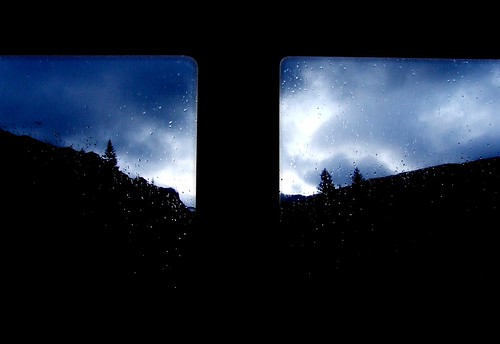
Remove the rain and place an african woman wearing a traditional head covering and dancing with hands raised to Jesus in front of the window and you get something of the abiding image etched on my brain when I walked into a church meeting in a hut at 6am one Sunday morning. It was small and simple, yet awesome!
Taken during our trek in the Mt Elgon National Park, Uganda.
If you look hard, you can see three different waterfalls! Views like that would cost you £100s in the UK. We got it for $4 each.
Psalm 130:5-6
The rock that looks like a dinosaur head!
Taken during our trek in the Mt Elgon National Park, Uganda.
Baboon viewpoint, Lake Nakuru National Park, Kenya:

Without a shadow of a doubt, one of the most, if not the most, amazing panorama I have ever seen. The image above, (found on Google, as I didn't take a camera.) CANNOT convey anything but a minuscule fraction of the wonder I felt standing there. It was like looking over Eden as a myriad of different animals serenely went about their business below in the warm sunshine. (I felt like Adam, waiting for Jesus to turn up and invite me to name some of them, I also had this music (from 3:54 onwards) playing in my head as I looked on, although not entirely sure why...) A truly exquisite experience, for which I'm very grateful.
Subscribe to:
Posts (Atom)